 1bb85de18d
Issue 8064 occurs when FreeCAD passes a Voronoi diagram to
Boost that becomes self-intersecting when Boost truncates the
diagram's coordinates to integers.  This occurs when the discretizer
slightly misses closing the polygon generated for the letter by less
that FreeCAD's epsilon, then the wrapping Python code closes the
polygon by adding the initial polygon point as the final point.
This creates a short segment that, depending on the position of
the letter in the coordinate system, may end up being moved one
Boost coordinate delta away from the intended point, which can
end up self-intersecting.
Since the miss is very small, FreeCAD should treat it as it it
were the initial point.  There's no need for a duplicate copy of
the initial point, so we remove this point close to the initial
point and let insert_many_wires() close the polygon as usual.

Your own 3D parametric modeler
Website • Documentation • Forum • Bug tracker • Git repository • Blog



Overview
-
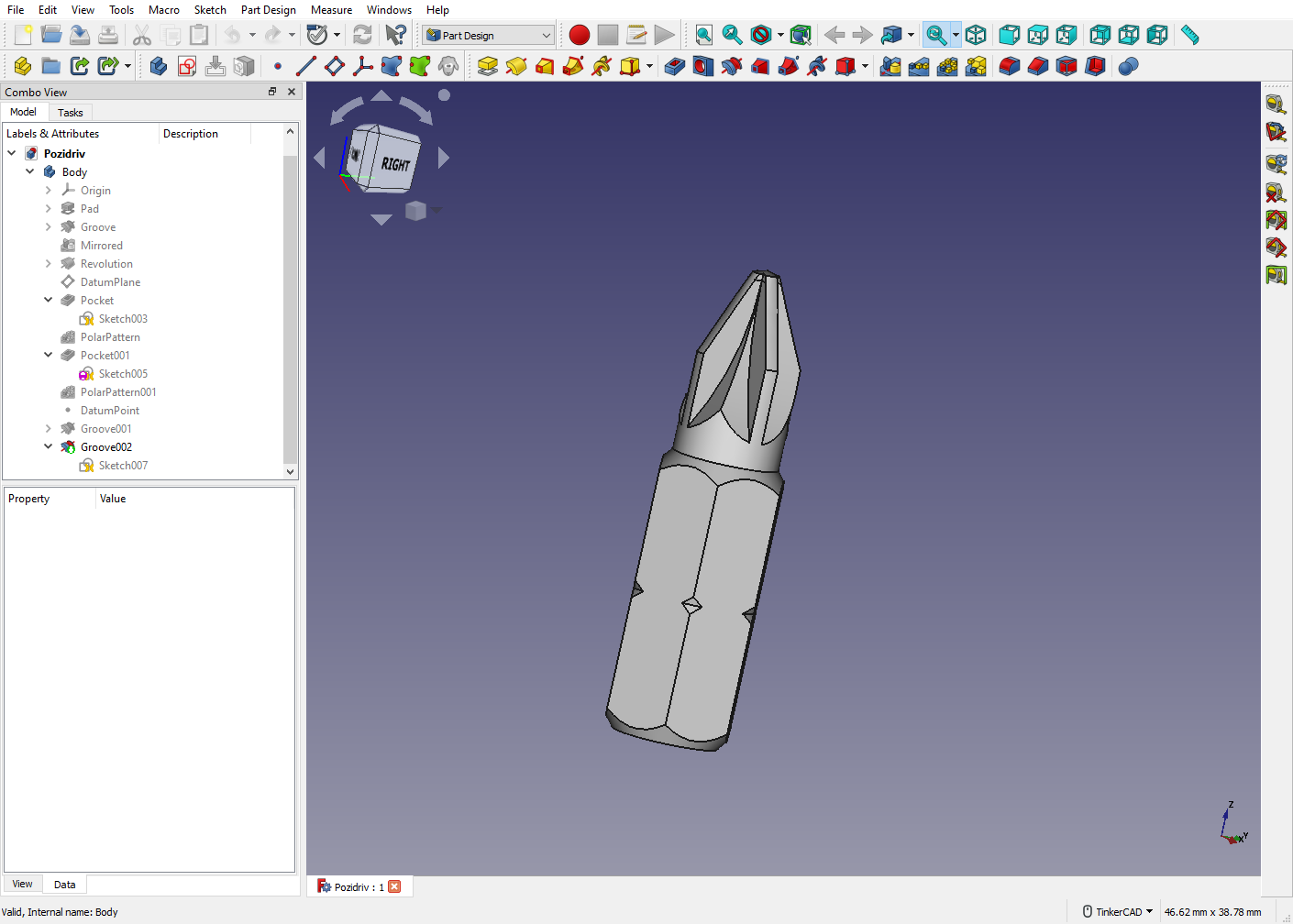
Freedom to build what you want FreeCAD is an open-source parametric 3D modeler made primarily to design real-life objects of any size. Parametric modeling allows you to easily modify your design by going back into your model history to change its parameters.
-
Create 3D from 2D and back FreeCAD lets you to sketch geometry constrained 2D shapes and use them as a base to build other objects. It contains many components to adjust dimensions or extract design details from 3D models to create high quality production-ready drawings.
-
Designed for your needs FreeCAD is designed to fit a wide range of uses including product design, mechanical engineering and architecture, whether you are a hobbyist, programmer, experienced CAD user, student or teacher.
-
Cross platform FreeCAD runs on Windows, macOS and Linux operating systems.
-
Underlying technology
- OpenCASCADE A powerful geometry kernel, the most important component of FreeCAD
- Coin3D library Open Inventor-compliant 3D scene representation model
- Python FreeCAD offers a broad Python API
- Qt Graphical user interface built with Qt
Installing
Precompiled packages for stable releases are available for Windows, macOS and Linux on the Releases page.
On most Linux distributions, FreeCAD is also directly installable from the software center application.
For development releases check the weekly-builds page.
Other options are described at the wiki Download page.
Compiling
Compiling FreeCAD requires installation of several libraries and their development files such as OCCT (Open Cascade), Coin and Qt, listed in the pages below. Once this is done, FreeCAD can be compiled with CMake. On Windows, these libraries are bundled and offered by the FreeCAD team in a convenient package. On Linux, they are usually found in your distribution's repositories, and on macOS and other platforms, you will usually have to compile them yourself.
The pages below contain up-to-date build instructions:
Reporting Issues
To report an issue please:
- First post to forum to verify the issue;
- Link forum thread to bug tracker ticket and vice-a-versa;
- Use the most updated stable or development versions of FreeCAD;
- Post version info from eg.
Help > About FreeCAD > Copy to clipboard; - Post a Step-By-Step explanation on how to recreate the issue;
- Upload an example file to demonstrate problem.
For more detail see:
The FPA offers developers the opportunity to apply for a grant to work on projects of their choosing. Check jobs and funding to know more.
Usage & Getting help
The FreeCAD wiki contains documentation on general FreeCAD usage, Python scripting, and development. These pages might help you get started:
The FreeCAD forum is also a great place to find help and solve specific problems you might encounter when learning to use FreeCAD.
This project receives generous infrastructure support from
 and KiCad Services Corp.